No-Shave FUE: Benefits of Discreet Hair Transplant Surgery
Why no-shave FUE is the preferred choice for patients who need a discreet procedure, and how it differs from traditional FUE.

For many people considering a hair transplant, the surgery itself is not the primary source of anxiety. What concerns them most is the recovery period, specifically the visible signs that broadcast to everyone around them that they have had a procedure. The shaved donor area, the telltale redness, the stubble pattern that takes weeks to grow out: these are the markers that make a traditional FUE transplant difficult to conceal, and they are the reason many patients delay treatment for months or even years.
No-shave FUE was developed specifically to address this barrier. By eliminating the need to shave the donor area, this technique allows patients to undergo hair restoration surgery while maintaining their existing hairstyle, making recovery virtually invisible to everyone around them. For professionals, public-facing individuals, and anyone who values privacy, it represents a significant advancement in how hair transplant surgery is performed.
What Is No-Shave FUE?
No-shave FUE, also known as unshaven FUE or long-hair FUE, is a variation of the standard Follicular Unit Extraction technique in which individual follicular units are extracted from the donor area without first shaving the surrounding hair. In a traditional FUE procedure, the donor area at the back of the head is typically shaved to a very short length (1-2 mm), which makes it easier for the surgeon to see and access the follicular units for extraction. No-shave FUE skips this step entirely, working around the existing long hair.
The fundamental surgical principles are identical to standard FUE. The same tiny circular punch is used to score around each follicular unit. The same careful extraction technique removes the grafts from the surrounding tissue. The same precision placement implants the grafts into the recipient area. The difference lies entirely in how the donor area is prepared, and this seemingly simple modification has profound implications for the patient's post-operative experience.
How the Extraction Technique Differs
In standard FUE, the shaved donor area gives the surgeon a clear, unobstructed view of each follicular unit. The punch can be positioned precisely around the follicular unit, and the angle of entry can be aligned with the natural growth direction of the hair. The shaved stubble also makes it easy to assess density and plan the extraction pattern.
In no-shave FUE, the surgeon must work around full-length hair shafts. Each hair selected for extraction is individually trimmed to a few millimeters in length, just enough to allow the punch to engage, while the surrounding hairs remain at their full length. This requires the surgeon to identify, isolate, and trim each target follicular unit one at a time before extracting it. The process demands significantly more time, precision, and technical skill than standard FUE.
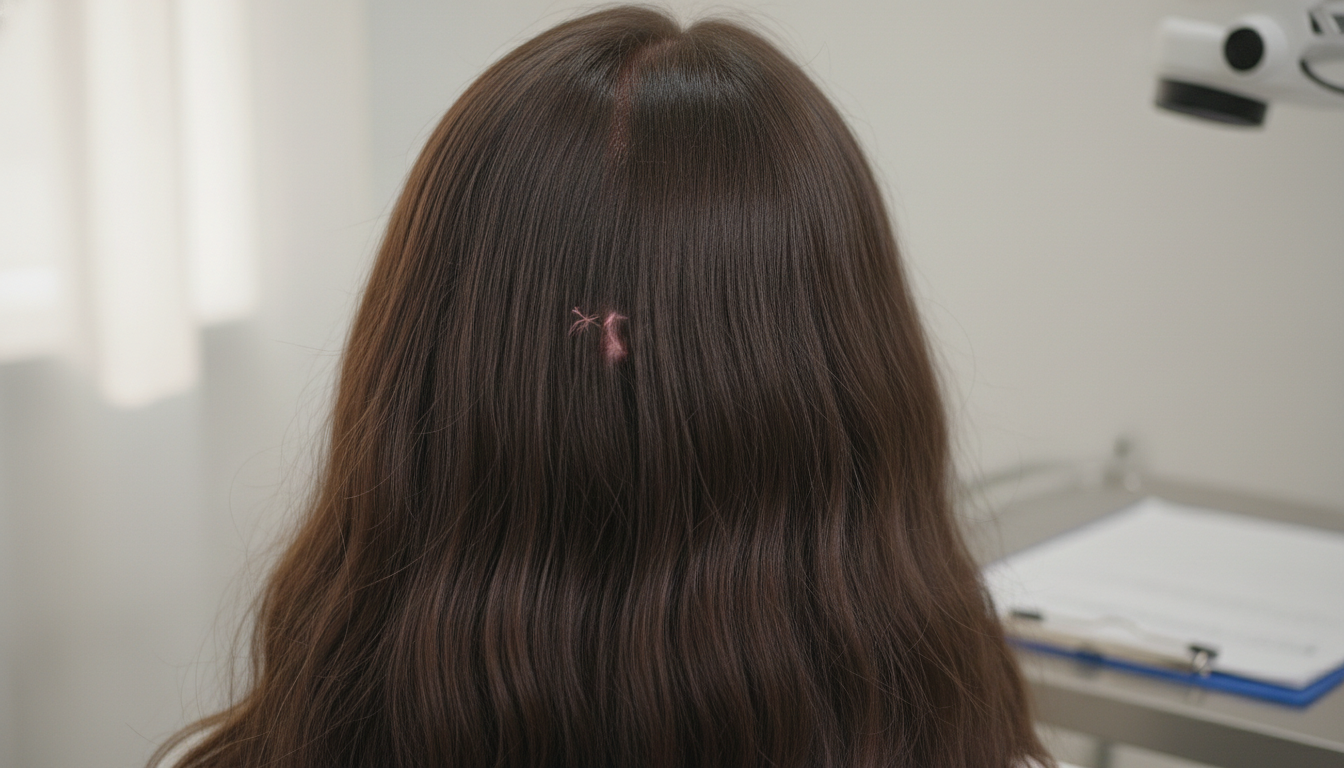
The extraction sites are concealed by the surrounding long hair almost immediately. Within hours of the procedure, the tiny extraction wounds are hidden beneath the patient's existing hairstyle, making the donor area appear essentially normal to a casual observer.
Who Benefits Most From No-Shave FUE
Working Professionals
Executives, attorneys, physicians, salespeople, and other professionals who interact face-to-face with clients or colleagues every day often cannot afford to take an extended leave of absence or explain a suddenly shaved head. No-shave FUE allows them to return to work within days with no visible indication that a procedure was performed. Many of our professional patients schedule their procedures on a Thursday or Friday and return to their normal work schedule by Monday.
Women
Women seeking hair restoration are among the most common candidates for no-shave FUE, and for obvious reasons. Most women wear their hair at medium to long lengths, and shaving the back of the head would be immediately noticeable and difficult to conceal while growing out. No-shave FUE allows women to maintain their hairstyle throughout the process, which is essential for many female patients who value privacy around their treatment.
Patients With Longer Hair
Anyone who wears their hair at a length that would make a shaved donor area conspicuous is a potential candidate. This includes men who wear their hair at medium length, individuals with curly or textured hair that would look dramatically different if shaved, and anyone who simply prefers not to alter their appearance for the procedure.
Patients Who Value Maximum Privacy
Some patients are comfortable telling friends and family about their hair transplant, while others prefer to keep it entirely private. No-shave FUE supports the latter preference completely. Even people who see the patient daily are unlikely to notice that a procedure has been performed, because the donor area shows no visible change and the recipient area's post-operative redness is typically mild and resolves within days.
Advantages of No-Shave FUE
- Completely discreet recovery. This is the defining advantage. The existing hair covers all evidence of the procedure in the donor area from day one. There is no awkward growth-out period, no need for hats or head coverings (beyond normal post-operative sun protection), and no conversations you do not want to have.
- Immediate return to normal appearance. You look like yourself before, during, and after the procedure. There is no transitional phase where your appearance is noticeably different.
- No workplace disruption. Most patients can return to professional environments within two to three days without anyone noticing a change. This eliminates the need to plan around vacation time or fabricate explanations for an altered appearance.
- Psychological comfort. Many patients report that knowing their procedure will be invisible to others significantly reduces pre-operative anxiety and improves their overall experience.
- Ideal for smaller sessions. For patients who need a moderate number of grafts, such as 500 to 1,500, no-shave FUE is particularly efficient and well-suited. The procedure can be completed in a reasonable timeframe while maintaining full discretion.
Limitations and Trade-offs
No-shave FUE is not the right choice for every patient or every situation. Understanding the limitations is just as important as understanding the benefits:
- Longer procedure time. Because each follicular unit must be individually identified, trimmed, and extracted from among full-length hairs, no-shave FUE takes significantly longer than standard FUE for the same number of grafts. A session that would take six hours with a shaved donor area may take eight to ten hours without shaving. This adds to both the patient's time commitment and the procedure cost.
- Fewer grafts per session. The more labor-intensive extraction process means that the maximum number of grafts achievable in a single no-shave session is typically lower than in a standard FUE session. While a standard FUE session might yield 3,000 to 4,000 grafts, a no-shave session is often limited to 1,500 to 2,500 grafts. Patients requiring higher graft counts may need multiple sessions or may be better served by standard FUE or FUT.
- Higher cost per graft. The increased time and technical demands translate to a higher per-graft cost compared to standard FUE. For patients comparing costs across techniques, this is an important factor to weigh against the discretion benefits.
- Requires greater surgical skill. Not all surgeons who perform standard FUE are equally proficient at no-shave FUE. The technique demands exceptional hand-eye coordination, patience, and experience working around long hair without damaging adjacent follicles. It is important to choose a surgeon with specific expertise in this variation.
- Not suitable for very large sessions. Patients who need 3,000 or more grafts in a single procedure are generally better candidates for standard FUE (with shaving) or FUT. The efficiency constraints of no-shave FUE make very large sessions impractical.
No-Shave FUE vs. Standard FUE: Which Should You Choose?
The decision between no-shave and standard FUE comes down to weighing your priorities:
Choose no-shave FUE if: Privacy is your top priority, you need a moderate number of grafts (under 2,500), you cannot take extended time away from professional or social obligations, you are a woman with longer hair, or you simply do not want to alter your appearance during recovery.
Choose standard FUE if: You need a large number of grafts in a single session, you are comfortable with the shaved appearance during recovery, you prefer to minimize procedure time and cost, or your hair is already worn very short and shaving would not represent a significant change.
Many patients who initially request no-shave FUE discover during consultation that their specific needs are better served by standard FUE, and vice versa. The discussion should always be guided by what will produce the best clinical outcome for your individual situation.
Cost Comparison
The cost of no-shave FUE is generally 20 to 30 percent higher per graft than standard FUE, reflecting the additional time, technical complexity, and surgeon skill required. For a 1,500-graft procedure, this premium may amount to several hundred to a few thousand dollars. For many patients, particularly working professionals who would otherwise need to take additional time off work or face questions about their appearance, the premium represents a reasonable investment in convenience and privacy.
What the Recovery Looks Like
The recovery experience after no-shave FUE is one of its most compelling features. In the donor area, the tiny extraction sites are immediately concealed by surrounding hair. There is no visible stubble, no bare-looking patch, and no obvious evidence of surgery. The small wounds heal within five to seven days, during which time they are essentially invisible to anyone who is not specifically inspecting your scalp at close range.
In the recipient area, the experience is similar to standard FUE. Small crusts form around each implanted graft and typically shed within seven to ten days. Mild redness may be present for a few days to a couple of weeks, and it can be easily concealed with existing hair styling or, if needed, a light application of cosmetic concealer. The transplanted hairs will go through the normal growth cycle, with new growth becoming visible at three to four months and the full result maturing over 12 to 18 months.
The ultimate measure of a great hair transplant is that no one knows you had one. No-shave FUE makes that goal achievable from the very first day of recovery.
Ideal Candidates for No-Shave FUE
The ideal no-shave FUE patient has moderate thinning that can be addressed with 1,000 to 2,500 grafts, wears their hair at a length sufficient to conceal the donor area extraction sites, places a high value on discretion, and understands the trade-offs in terms of cost and session capacity compared to standard FUE. During consultation, we evaluate each patient's specific anatomy, hair characteristics, goals, and lifestyle to determine whether no-shave FUE is the optimal approach or whether another technique would better serve their needs.
If privacy during recovery is important to you and you are considering hair restoration, we encourage you to schedule a consultation to discuss whether no-shave FUE is right for your situation. At Bellevue Hair Doctor, we have extensive experience performing this technique and can help you understand exactly what to expect from both the procedure and the recovery.
Related Articles
FUE vs FUT: Which Hair Transplant Method Is Right for You?
A detailed comparison of Follicular Unit Extraction and Follicular Unit Transplantation covering scarring, recovery, cost, and graft yield.

Female Hair Loss: Common Causes and Treatment Options
Why women experience hair thinning and loss, from hormonal shifts to medical conditions, and which treatments deliver real results.

Hair Transplant Recovery Timeline: What to Expect
A week-by-week guide to hair transplant recovery, from the first 48 hours through the full 12-month growth cycle.
Schedule Your Free Consultation
Have questions about hair loss or treatment options? Our board-certified specialists are here to help.